REVIEW · COPENHAGEN
Sights & Gems: Medieval Copenhagen & Nyhavn with a local host
Book on Viator →Operated by Go like a local · Bookable on Viator
Two hours can still feel like old Copenhagen. This tight walking tour links headline sights with lesser-seen streets, then ends at Nyhavn where you can grab a coffee right by the water. I like how the route is built to give you quick, clear context for the city’s medieval and royal eras.
I also love the mix of iconic landmarks and calmer corners, like Nyboder’s preserved naval-life rooms and the characterful streets of Krusemyntegade. You get both the big wow (Marble Church’s dome, Rosenborg’s fairytale silhouette) and the quieter feel of Copenhagen’s everyday history.
One thing to consider: the stop time is short. You’ll see plenty, but if you want long interiors, this walk may feel a bit fast—it’s more about orientation than deep museum time.
In This Review
- Key things I’d mark on your mental map
- Start at Marmorkirken: finding the group by the Metro stairs
- Frederiks Kirke’s marble dome: the 150-year architecture lesson
- Nyboder naval quarter: memorial rooms and Krusemyntegade’s quiet streets
- Rosenborg Castle and King’s Garden: royal calm you can photograph
- The Round Tower’s spiral: an observatory built in 1642
- Gråbrødretorv and Amagertorv: squares for people-watching breaks
- Christiansborg Palace and Nikolaj Church: democracy, medieval spires, and outside views
- From Kongens Nytorv to Nyhavn: finish with café time by the canal
- English guiding and small-group value at $28.43
- Pacing, weather, and who this walk fits best
- Should you book this Medieval Copenhagen to Nyhavn walk?
- FAQ
- How long is the tour?
- Where do you meet the guide?
- How many people are in the group?
- Is the tour offered in English?
- Are tickets included for each stop?
- Where does the tour end?
- Can I cancel for a full refund?
Key things I’d mark on your mental map
- A 2-hour loop that hits many of Copenhagen’s top landmarks without feeling like a race
- Small group (max 12), so you’re not lost in a crowd while questions fly
- Frederiks Kirke is free and a perfect “wow” start with its oversized marble dome
- Nyboder focuses on naval families and preserved rooms that show daily life, not just monuments
- Nyhavn is the finish line with cafés and a canal view waiting at the end of the walk
Start at Marmorkirken: finding the group by the Metro stairs
Your tour begins near Frederiks Kirke (Marmorkirken), at the point between the stairs that go down to the Marble Church Metro Station. It’s right by a 7-Eleven, which makes meeting up simple even if you’re still figuring out the neighborhood.
The address is listed as Marmorkirken 1264, Copenhagen, and you’re also told it’s near public transport. That matters because you can arrive, meet your guide without stress, and then focus on the walk instead of the logistics.
You’ll also use a mobile ticket, which usually means fewer “where’s my printout?” headaches. With a group cap of 12, the whole experience feels structured, not chaotic.
You can also read our reviews of more tours and experiences in Copenhagen.



Frederiks Kirke’s marble dome: the 150-year architecture lesson
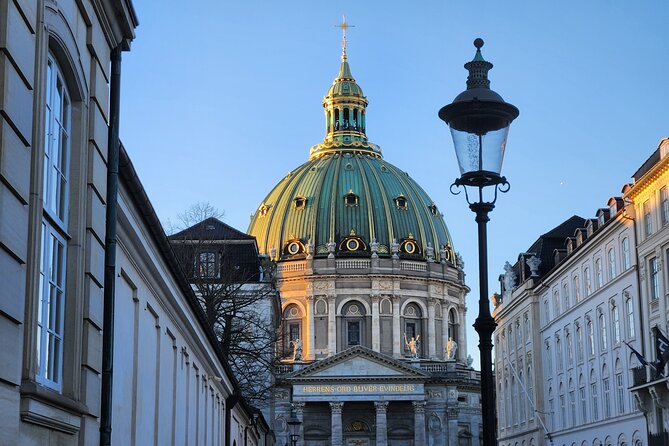
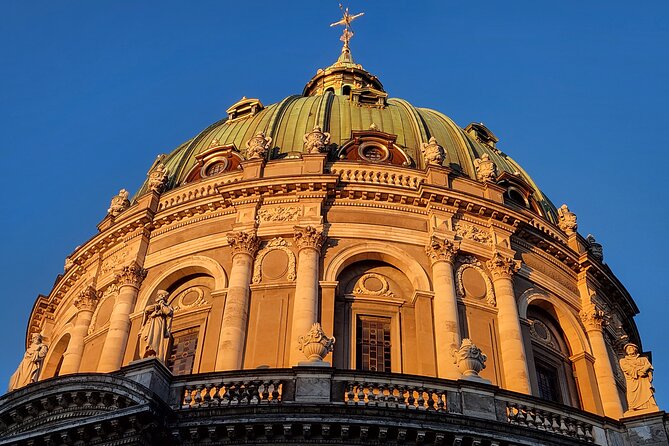
The first stop is Frederiks Kirke, also called Marmorkirken or the Marble Church. It’s famous for its massive dome—the largest in Scandinavia—and it took more than 150 years to complete. The church also draws inspiration from St. Peter’s Basilica in Rome, which gives you a fun way to connect Copenhagen’s architecture to older European design traditions.
The building material is Norwegian marble, and the guide uses that fact to point out craftsmanship details while you’re standing in the right spot for photos. Admission is listed as free, so you don’t have to budget extra just to enjoy the outside and the overall setting around Frederiksstaden.
I like this start because it sets the tone for the whole tour: you’re not just “seeing buildings,” you’re learning why they look the way they do and how Danish ambition shaped what you see today.
Nyboder naval quarter: memorial rooms and Krusemyntegade’s quiet streets
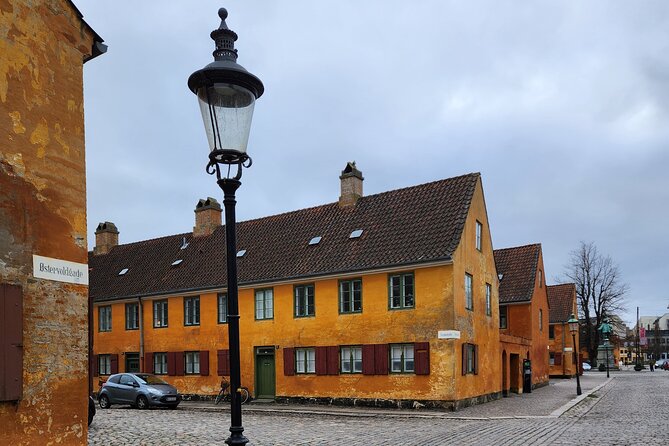
Next comes Nyboder, Copenhagen’s historic naval quarter, founded in 1631 by King Christian IV to house Denmark’s naval families. This is where the tour slows down into something more human-scale than royal palaces.
You stop by the Nyboder Memorial Rooms, described as small preserved museum spaces. You can peek through windows and catch scenes that hint at life centuries ago. Tickets aren’t included here, so if you want to go inside more than the quick exterior viewing, you’ll need to plan for that separately.
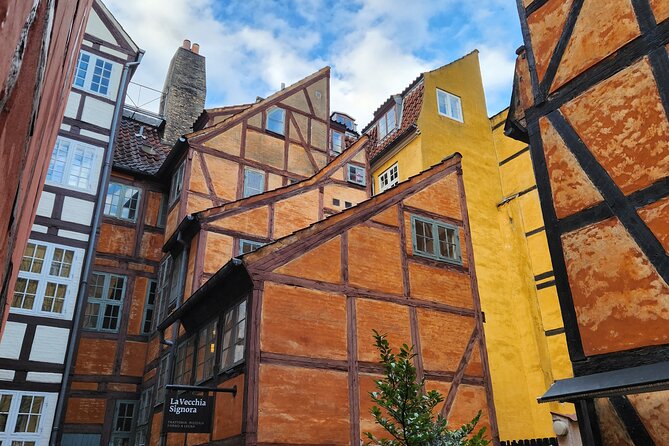
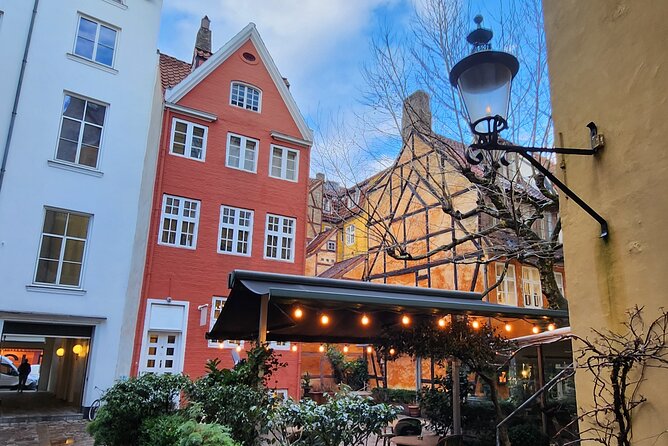
Then the walk continues through Krusemyntegade, a peaceful street lined with colorful, historic houses in the Nyboder area. The point isn’t a lecture—it’s a stroll. You get that “Copenhagen lived here” feeling: maritime families, old architecture, and a calmer pace than you’ll find in the busiest center streets.
I think this section is the best antidote to a common Copenhagen mistake. A lot of first-time visits only chase the famous facades. Nyboder and Krusemyntegade help you notice the city’s earlier purpose and its everyday rhythms.
Rosenborg Castle and King’s Garden: royal calm you can photograph
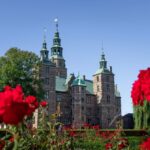
Rosenborg Castle is a highlight for many people, and the tour treats it like a breather. It was built by King Christian IV in the early 1600s and sits in King’s Garden (Kongens Have), described as Denmark’s oldest royal park.
You’ll admire the castle from the outside, with the gardens giving you a calmer backdrop right when the walk could start to feel long. The castle is Renaissance-style, and even without entering, it’s a strong visual anchor for what Christian IV was building at the time.
Admission isn’t included for this stop, so you’ll mostly be working with exterior views and the garden atmosphere. If you’re the type who loves photos, this is one of your best chances to get shots that look like a postcard but still feel connected to real city life.
The Round Tower’s spiral: an observatory built in 1642
From palace gardens to science history: the next exterior stop is the Round Tower (Rundetårn). It was built in 1642 by Christian IV, and it was created as Europe’s oldest functioning observatory.
The tower’s spiral design and copper-clad roof are key visual elements from the street level. You don’t have to climb to understand the idea: the tower is Copenhagen’s proof that the city wanted both culture and curiosity.
Tickets aren’t included, and you’re mainly there for viewing and a photo stop. Still, it lands well in the overall route, because it shifts the story from royal power to intellectual ambition.



Gråbrødretorv and Amagertorv: squares for people-watching breaks
After the royal and historic anchors, the tour moves into the street-level charm of Copenhagen squares.
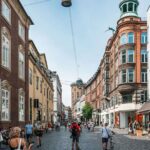
First is Gråbrødretorv, a picturesque square shaded by large trees, surrounded by colorful historic townhouses. There are cozy cafés and restaurants nearby, and admission is listed as free. This stop works as a mental reset: you can look up at the buildings, then look sideways at the day-to-day city scene.
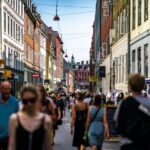
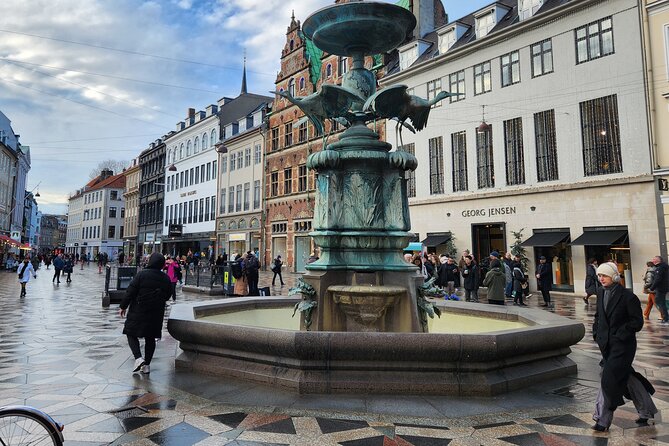
Then comes Amagertorv in the Strøget shopping district, centered on the Stork Fountain. It’s described as a hub of activity with elegant surrounding architecture and mosaic pavement. Admission is also listed as free here.
I like that these square stops are short but purposeful. They keep the tour from turning into a long string of standing still near stone monuments.
Christiansborg Palace and Nikolaj Church: democracy, medieval spires, and outside views
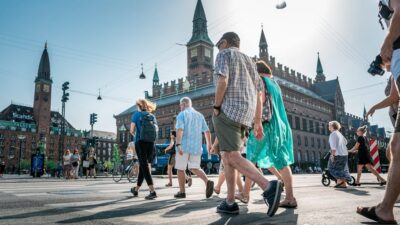
The tour heads to Christiansborg Palace on Slotsholmen Island, one of the city’s important landmarks. The building’s story is the biggest contrast point on the walk: it’s built on centuries of royal foundations, and today it houses Denmark’s Parliament, Supreme Court, and Royal Reception Rooms. The listing adds that it’s the only building in the world that unites all branches of government under one roof.
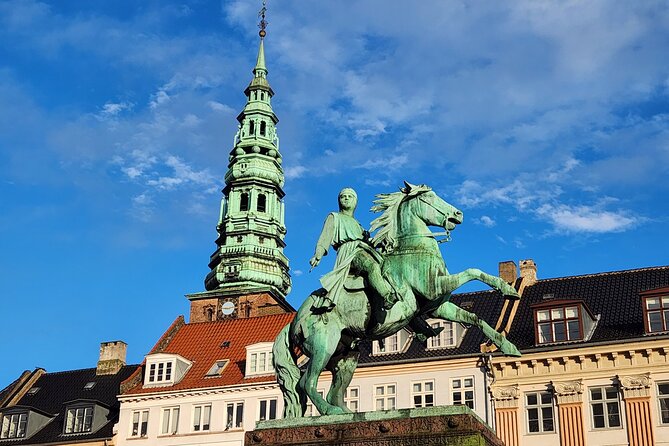
From the outside, you get the grand façade and an ornate copper spire, plus a guided storyline about kings, queens, fires, and political intrigue across more than 800 years. Tickets aren’t included here, so your time is spent on the exterior and the context the guide provides.
Next is the Nikolaj Church area (listed as Nikolaj Kunsthal). You’ll admire Nikolaj Church from the outside with its historic spire. It was originally built in the 1200s and is now described as a symbol of the city’s architectural past. Again, tickets aren’t included, so you’re treating this as a photo and skyline moment.
This “outside-only” approach can be a drawback if you love interiors. But it also keeps your day moving and lets you stack stories together without losing time to lines.
From Kongens Nytorv to Nyhavn: finish with café time by the canal
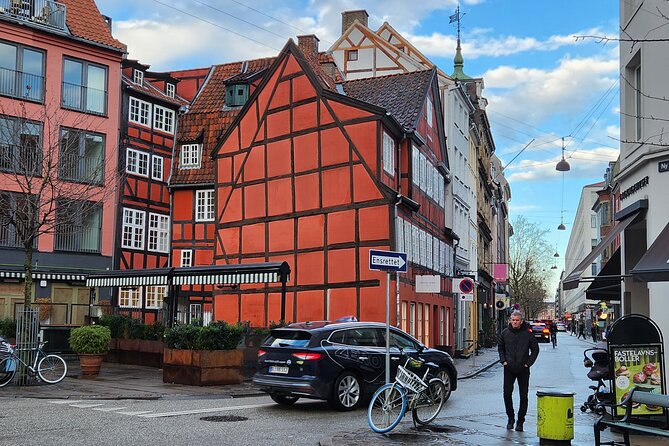
The route ends by easing you into Copenhagen’s most famous canal scene.
First you reach Kongens Nytorv, Copenhagen’s grand central square. You’re told it’s surrounded by landmarks like the Royal Danish Theatre and Hotel d’Angleterre, and there’s also an equestrian statue of King Christian V. Admission is listed as free, so this is mainly about orientation and atmosphere.
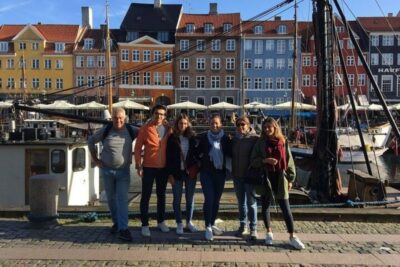
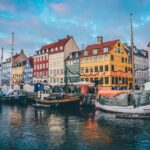
Then you walk into Nyhavn, Copenhagen’s colorful waterfront district. Here you’ll see 17th-century townhouses, historic wooden ships, and the modern café culture that grew out of an older trading harbor. The tour notes that Hans Christian Andersen once lived here, and it connects his story to how the canal became one of Europe’s most photographed streets.
The tour ends at Nyhavn 28, and that’s a practical gift: you’re done, you’re near food, and you can keep going at your own pace. If the weather holds, this ending is hard to beat. Even in less-than-perfect conditions, the canal gives you that immediate Copenhagen feeling—cozy, story-heavy, and easy to linger in.
English guiding and small-group value at $28.43
At $28.43 per person for about 2 hours, this is priced like a solid “first introduction to the city” experience. You’re paying for a live local guide plus an efficient route that packs a lot of landmarks into a manageable walking window.
The group cap of 12 matters more than it sounds. With smaller groups, you can actually hear the guide, ask follow-ups, and keep a steady pace. The tour also offers group discounts, and it’s offered in English, which is helpful if you’re relying on clear explanations.
The way guides handle the real Copenhagen weather is a big part of whether a walking tour works. In the reviews, I saw examples of the guide adapting when it got wet and windy—one guide found a warm coffee lounge and continued telling stories from inside. That’s exactly the kind of flexibility you want on a short schedule.
Two more review-based points that connect to value:
- Clear English was highlighted with a guide named Maybritt, with people saying it was easy to understand and that they learned a lot.
- Another guide named Maybee was credited with turning bad weather into a comfortable break while still covering key highlights.
Also, many stops are listed as free or outside-only. Frederiks Kirke is free, Gråbrødretorv is free, and Amagertorv is free. Nyhavn is free. If you keep expectations realistic—think short viewing stops rather than full museum immersion—you’ll feel you got your money’s worth.
Pacing, weather, and who this walk fits best
This tour is designed for moderate physical fitness, and you should expect a walking rhythm with quick stops. Many stops are described in very short time slices, which makes sense for a 2-hour total, but it also means you won’t have time to read every plaque or do lengthy interior visits.
You’ll also be outdoors for much of the walk. Pack for real weather. Copenhagen can shift quickly, and one review shows the guide is ready to adjust. Still, bring layers and something rain-friendly if the forecast looks even slightly uncertain.
Who should join? This walk is ideal if:
- you want a fast orientation to medieval and royal Copenhagen
- you like architecture and city storytelling, not just checking boxes
- you’re trying to see a lot without spending the whole day on buses and trains
If you already know Copenhagen’s basics and want deep interior experiences at each site, you might prefer a longer, ticket-heavy tour. Here, the strength is focus: many famous exteriors, plus the more personal Nyboder section and a memorable finish in Nyhavn.
Should you book this Medieval Copenhagen to Nyhavn walk?
I’d book it if you want a high-value Copenhagen introduction that ends in the city’s most satisfying “sit down with a pastry” finale. For the money, you get a small group, clear English guidance, and a route that mixes big landmarks (Marble Church, Rosenborg, Round Tower, Christiansborg) with more grounded neighborhood texture in Nyboder.
I’d skip or adjust expectations if you’re the type who needs long museum time, deep cathedral interiors, or long answers to one specific interest. This is built for overview and context, and it does that well—especially when the guide keeps things moving and still finds shelter when weather turns.
FAQ
How long is the tour?
It’s approximately 2 hours.
Where do you meet the guide?
You meet between the stairs leading down to the Marble Church Metro Station, right next to a 7-Eleven, at Marmorkirken 1264, Copenhagen.
How many people are in the group?
The tour has a maximum of 12 travelers.
Is the tour offered in English?
Yes, it’s offered in English.
Are tickets included for each stop?
Some stops are free. Frederiks Kirke is listed as free, Gråbrødretorv and Amagertorv are listed as free, and Nyhavn is listed as free. Nyboder Memorial Rooms has ticketing not included, and several other stops are listed as not included.
Where does the tour end?
It ends at Nyhavn 28, 1051 Indre By, Denmark.
Can I cancel for a full refund?
Yes. There is free cancellation, and you can cancel up to 24 hours in advance for a full refund.